The Ultimate Guide to Understanding Front-End Services Everywhere


.svg)


What Front-End Services Really Mean for Your Digital Experience
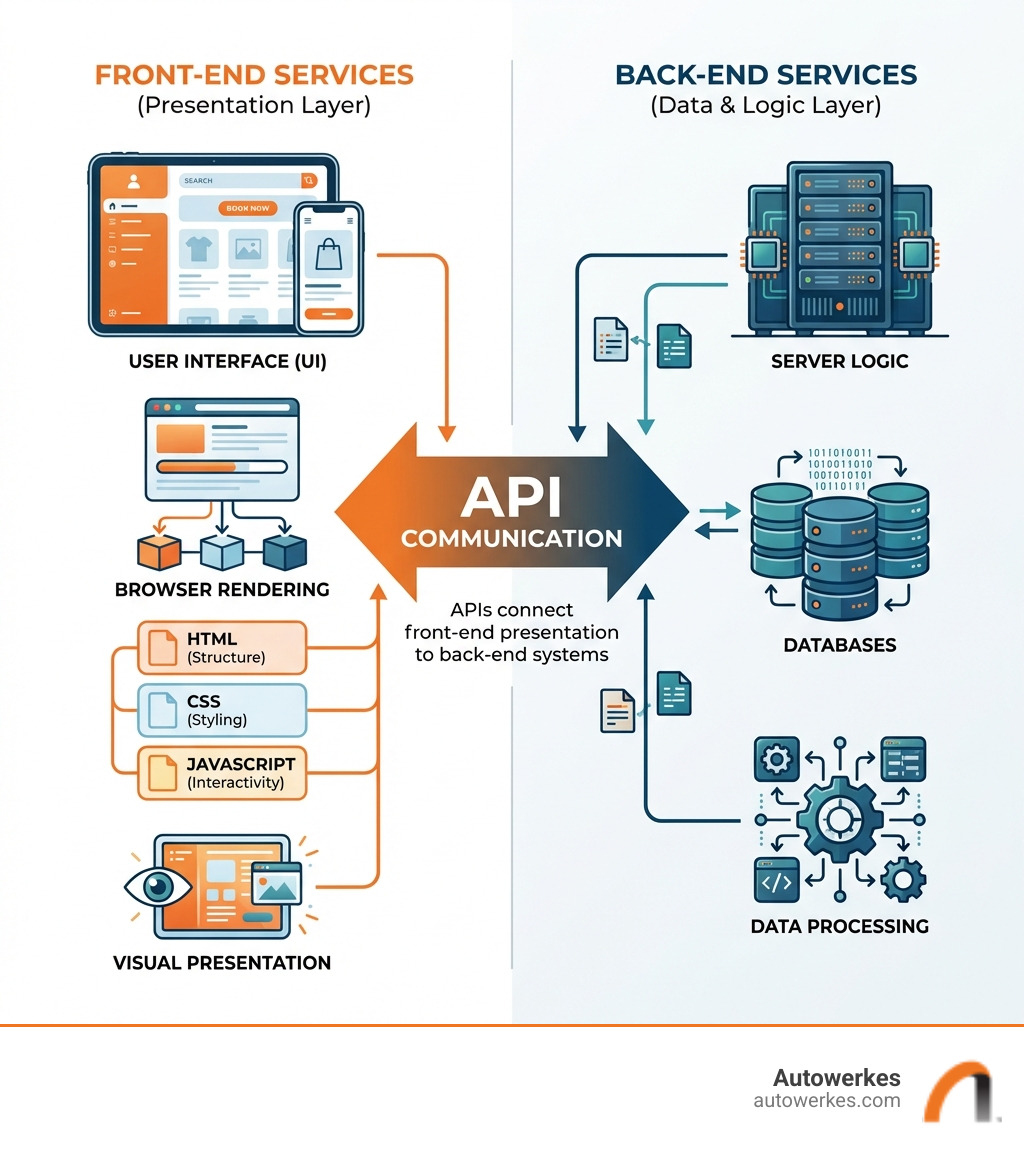
Front-end services are the visible, interactive parts of websites and applications that users directly engage with—the buttons you click, the forms you fill out, the images you see, and the menus you navigate. Think of them as the digital dashboard of your luxury vehicle: sleek, responsive, and designed to give you complete control without needing to understand what's happening under the hood.
Quick Definition:
- Front-End Services = Everything users see and interact with (the presentation layer)
- Core Technologies = HTML (structure), CSS (styling), JavaScript (interactivity)
- Key Purpose = Creating seamless user experiences across devices
- Communication Method = APIs connect front-end to back-end systems
- Modern Approach = Frameworks like React, Angular, and Vue.js power today's interfaces
Just as your Porsche's dashboard displays critical information while hiding complex engine operations, front-end services present data and functionality in an intuitive way. The back-end handles the heavy lifting—databases, servers, and business logic—while the front-end focuses entirely on your experience.
In 2021, US eCommerce sales hit $870 billion, a 50.5% increase over 2019. This explosive growth happened because businesses invested heavily in front-end services that made online shopping feel effortless. The same principle applies whether you're browsing products, checking your bank balance, or scheduling maintenance for your luxury vehicle.
The difference matters because poor front-end design frustrates users, while excellent front-end services feel invisible. When you book a service appointment online and the process flows smoothly, that's front-end excellence at work. When forms break, pages load slowly, or buttons don't respond, that's a front-end failure.
The Evolution of Modern Front-End Services
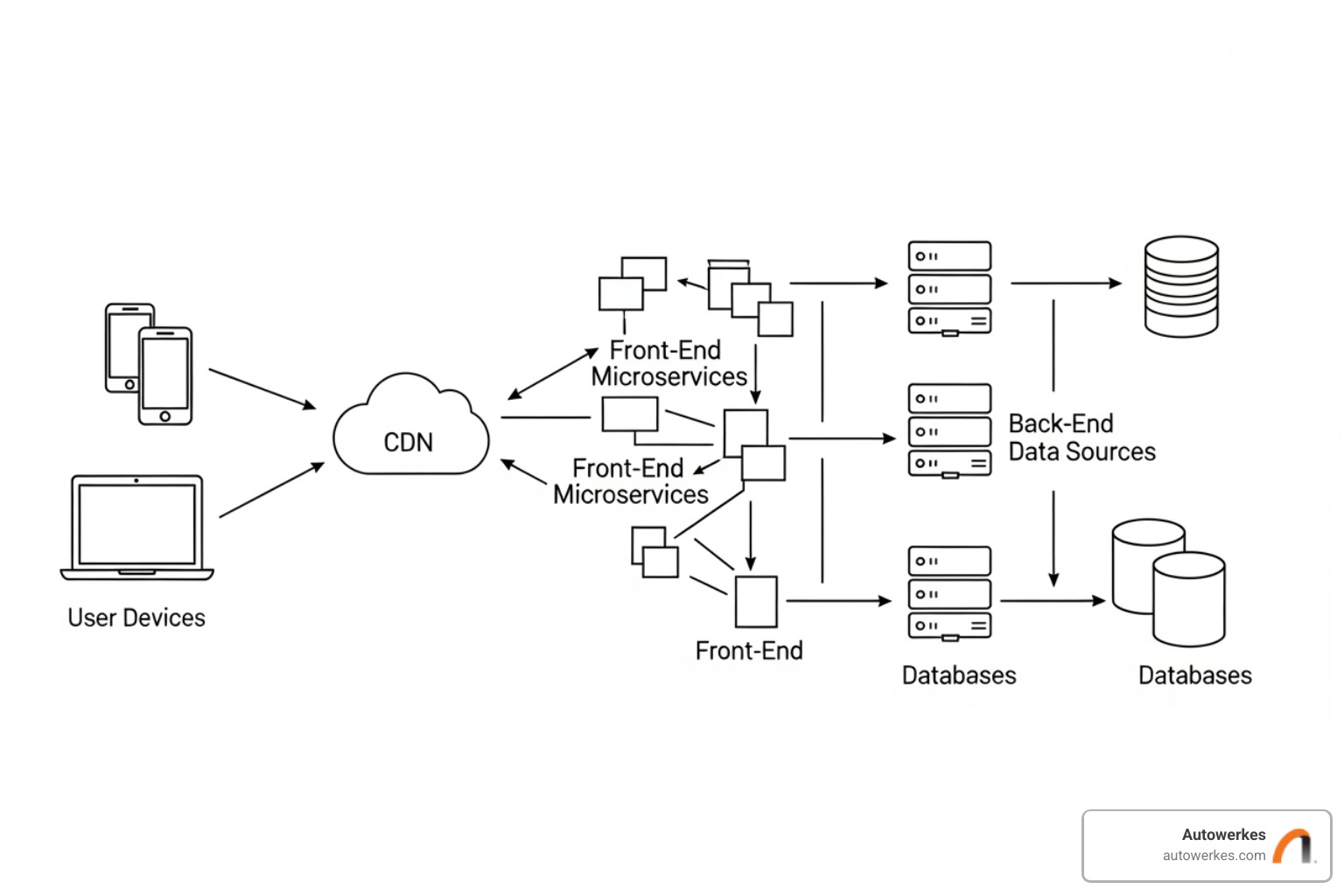
In the early days of the web, the "front-end" was little more than static text and perhaps a grainy image of a car. Today, it has evolved into a sophisticated ecosystem of front-end services that operate almost like independent pieces of software. We’ve moved from simple pages to "composable" architectures where different parts of a website—the search bar, the checkout, the booking calendar—are managed as specialized services.
This shift is often referred to as MACH architecture (Microservices, API-first, Cloud-native, and Headless). For luxury brands and service providers from Huntington Beach to Newport Beach, this means the ability to update the "look and feel" of a site without breaking the underlying data.
According to data from the US Department of Commerce Retail Indicator Division, the massive spike in eCommerce sales has forced a revolution in how we think about "Frontend as a Service" (FEaaS). FEaaS allows companies to use pre-built components to assemble a high-end digital experience quickly. It’s a bit like how a Mercedes-Benz Brake Repair requires specific, high-quality components designed to fit perfectly into a larger, complex system. By using these modular services, developers can focus on the user experience (UX) rather than reinventing the wheel every time they build a new page.
Core Technologies Powering Front-End Services
To understand how these services work, we need to look at the "Big Three" of web development, plus the modern frameworks that have taken over the industry.
- HTML (HyperText Markup Language): This is the skeleton. It provides the structure of the page. Without HTML, there would be no buttons to click or text to read.
- CSS (Cascading Style Sheets): This is the paint job and the interior leather. It dictates the colors, fonts, and layout. It ensures that whether you are in Irvine or Manhattan Beach, the website looks premium on your iPhone or your desktop.
- JavaScript (JS): This is the electrical system. It handles the logic—what happens when you click a button? How does the gallery of Porsche 911s slide from left to right?
In recent years, developers have moved toward frameworks like React, Angular, and Vue.js. These tools allow us to build complex front-end services that are fast and reactive. Instead of reloading the whole page every time you click something, only the specific part of the page that needs to change is updated. This results in a "snappy" feel that mirrors the responsive handling of a fine-tuned BMW.
For a deeper dive into these distinctions, the article "Front End vs Back End of Your Website: Everything You Need to Know" explains that while the front-end focuses on client-side rendering (what happens in your browser), the back-end is busy with server-side processing.
Communication and the BFF Pattern in Front-End Services
How does the dashboard know the engine is low on oil? Through sensors and communication lines. In web development, front-end services talk to the back-end via APIs (Application Programming Interfaces).
Common communication methods include:
- REST (Representational State Transfer): The traditional "request and response" model.
- GraphQL: A modern query language that allows the front-end to ask for exactly the data it needs, and nothing more. This is great for performance because it reduces the amount of data traveling over the cellular networks in places like Palos Verdes or San Diego.
One of the most important architectural shifts is the Backends for Frontends (BFF) pattern. As we use more devices—phones, tablets, smartwatches, and car screens—a single back-end often can't serve them all efficiently. The Backends for Frontends pattern by Sam Newman suggests creating a small, dedicated back-end "adapter" for each specific front-end.
Comparison: BFF vs. Shared Backend
| Feature | Shared Backend Service | Backend for Frontend (BFF) |
|---|---|---|
| Complexity | High (one size fits all) | Low (tailored to one device) |
| Performance | Slower (excess data sent) | Optimized (only needed data sent) |
| Team Autonomy | Limited (teams must coordinate) | High (front-end team owns their BFF) |
| Maintenance | Difficult to update without breaking | Easier to iterate on specific interfaces |
Optimizing Performance and Security for the User Experience
When you bring your car into our Huntington Beach shop, we don't just look at the outside; we plug in diagnostic tools to ensure the software is running perfectly. Similarly, front-end services must be optimized for both speed and security.
Performance is a major factor in user retention. If a page takes more than three seconds to load, most users will bounce. This is why we use techniques like:
- Client-Side Rendering (CSR): The browser does the work, which is great for highly interactive apps.
- Server-Side Rendering (SSR): The server sends a fully formed page, which is better for SEO and initial load speed.
Security is equally vital. Unlike the back-end, which is hidden behind firewalls, the front-end is "exposed" to the user. We must implement strict validation to ensure that a user can't inject malicious code into a form. Using HTTPS is the bare minimum; modern front-end services also use Content Security Policies (CSP) to prevent unauthorized scripts from running. This level of care is exactly what we apply during a Porsche Brake Repair—ensuring every safety protocol is met so the driver is protected.
Enhancing Reliability with Service Workers
Have you ever tried to use an app while driving through a tunnel in Laguna Beach and had it fail because you lost signal? Service Workers are the solution to this problem.
A service worker is a script that your browser runs in the background, separate from the web page. It acts as a proxy between your browser and the network. According to the Service Worker API - Web APIs | MDN, these scripts enable:
- Offline-first experiences: You can still interact with the app even without an internet connection.
- Background Sync: The app can wait until you have a signal to send that "Schedule Appointment" request.
- Push Notifications: Keeping you updated on your vehicle's status in real-time.
The lifecycle of a service worker—Download, Install, and Activate—ensures that the user always has the latest version of the app without needing to manually refresh. It’s like a silent over-the-air update for your car's navigation system.
Cloud-Native Development and Testing
Building modern front-end services is made much easier by cloud providers like AWS. Tools like AWS Amplify allow developers to build full-stack apps in hours rather than weeks. It manages the hosting, the authentication (login), and the database connection automatically.
AWS AppSync uses GraphQL to make sure that data stays synchronized across all your devices. If you update your contact info on your laptop in Fountain Valley, it will show up instantly on your phone in Mission Viejo.
To ensure everything works across the thousands of different phone models out there, we use AWS Device Farm. This allows developers to test their front-end services on real, physical devices in the cloud. We believe in the same rigorous testing for every BMW Brake Repair we perform—testing under real-world conditions is the only way to guarantee performance.
Conclusion: Why Quality Front-End Services Matter
At the end of the day, front-end services are about communication. They are the bridge between a human being and a complex digital system. Whether you are browsing for a new home in Los Angeles or looking for the best premium auto repair in Huntington Beach, the quality of that digital interface dictates your level of trust in the brand.
We understand that our clients in Huntington Beach, Newport Beach, and Irvine expect excellence. That’s why we treat our digital presence with the same precision we use when servicing a Mini or a Mercedes-Benz. A smooth, well-designed front-end tells you that the company cares about the details.
If your luxury vehicle's "front-end"—its dashboard or sensors—is giving you trouble, or if it's just time for your scheduled maintenance, we are here to help. From brake repairs to complex engine diagnostics, our expert technicians provide the high-end service your vehicle deserves.
Ready to give your Porsche, BMW, or Mercedes-Benz the care it deserves? Visit our Services page to see how we can help keep your vehicle in peak condition.
Schedule your appointment today at Autowerkes and experience the difference that expert attention makes.