The Real Cost of a Professional Radiator Flush


.svg)


Why Your Luxury Vehicle's Cooling System Deserves Expert Attention
A coolant flush service is a professional maintenance procedure that removes old coolant from your vehicle's cooling system, flushes out contaminants, and refills it with fresh coolant to prevent overheating and engine damage.
Quick Answer for Evaluating Professional Service:
- What's Included: System inspection, pressure testing, complete drain of old coolant, distilled water flush, refill with manufacturer-specified coolant
- Service Duration: 20 minutes to 1 hour depending on vehicle complexity
- Typical Interval: Every 30,000 miles or 2 years (some long-life coolants last 60,000 miles/5 years)
- Why Professional Matters: Proper disposal, correct coolant type, air pocket prevention, component inspection
- Key Signs You Need Service: Dashboard warning light, overheating, discolored coolant, sweet smell, visible leaks
Have you ever felt that moment of panic when your temperature gauge climbs into the red zone? Or noticed a sweet, maple syrup-like smell coming from under the hood? These are your vehicle's desperate signals that its cooling system needs attention.
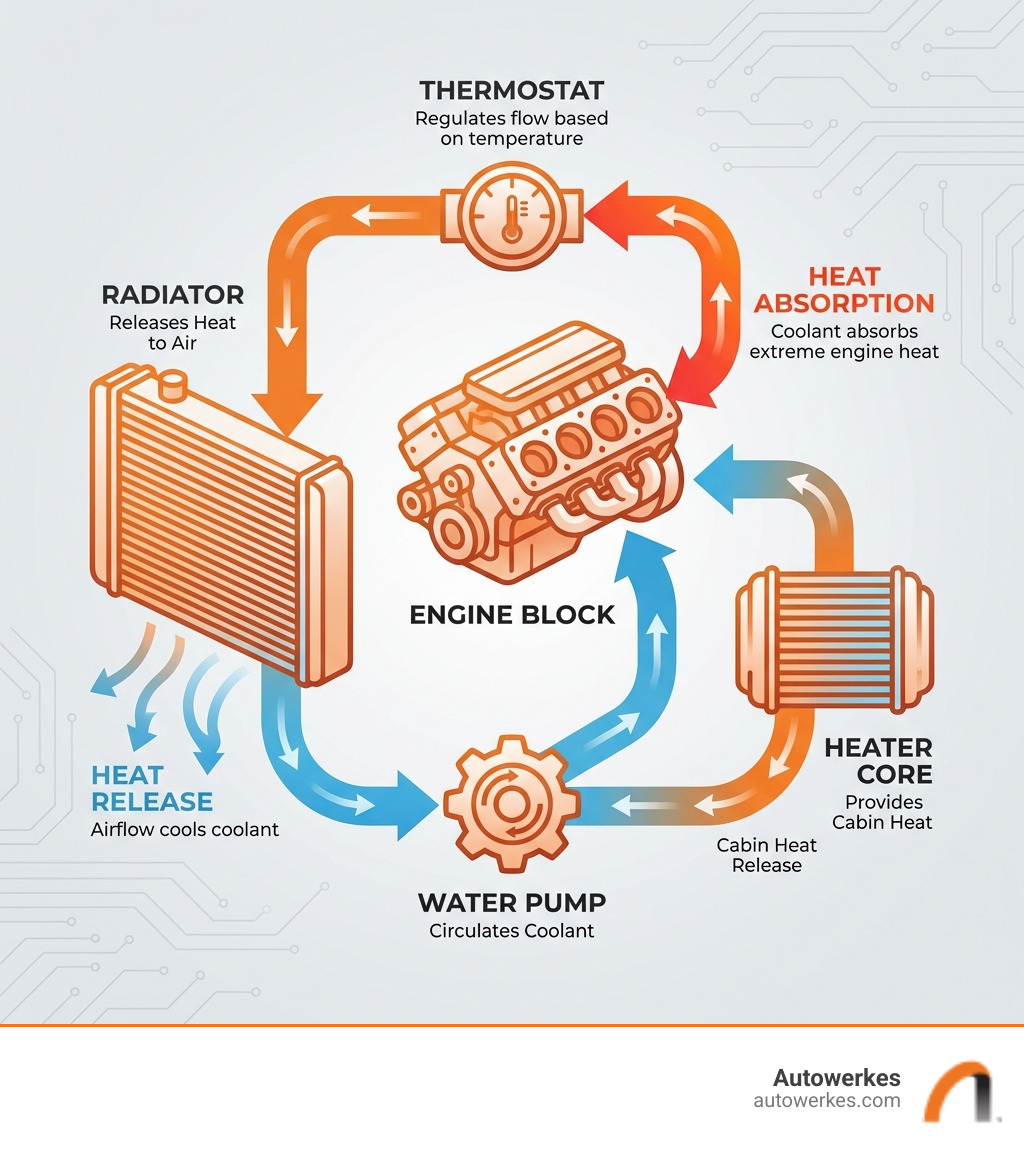
Your luxury vehicle's engine generates enormous heat—enough to warp metal and destroy components worth thousands of dollars. The cooling system circulates coolant through the engine block, radiator, water pump, and heater core in a continuous loop, absorbing and releasing heat to maintain optimal operating temperature.
But coolant isn't just colored water. It's a carefully formulated mixture of antifreeze (ethylene glycol or propylene glycol) and water with additives that prevent corrosion, lubricate components, and protect against both freezing and boiling. Over time, these protective additives break down, leading to rust, scale buildup, and mineral deposits that block coolant flow.
For Porsche, BMW, and Mercedes-Benz owners who demand precision engineering, choosing between professional service and DIY maintenance isn't just about saving money—it's about protecting your investment with the right expertise, tools, and manufacturer-specific knowledge.
Understanding the coolant flush service and Its Importance
In Huntington Beach and the surrounding coastal communities, we often subject our vehicles to a mix of stop-and-go traffic and high-speed freeway driving. This puts a significant load on the cooling system. A coolant flush service is not just a simple "drain and fill." It is a comprehensive cleaning process that ensures the heart of your car doesn't literally melt down.
Engine coolant serves three primary roles:
- Heat Transfer: It carries combustion heat away from the engine block to the radiator.
- Antifreeze Protection: It prevents the liquid from freezing in colder climates (even if we only see "cold" as 50 degrees in Newport Beach, your car might travel!).
- Corrosion Inhibition: It contains chemicals that coat the internal metal, plastic, and rubber parts to prevent rust and degradation.
Over time, these chemicals lose their effectiveness. When the pH balance shifts, the fluid becomes acidic, eating away at your aluminum radiator or water pump impeller. Furthermore, older vehicles IAT vs OAT vs HOAT comparisons show that using the wrong technology can lead to catastrophic internal clogs.

What Happens During a Professional coolant flush service?
When you bring your Porsche or BMW to us for a coolant flush service, we don't just pull a plug. We perform a systematic restoration of the cooling loop. Here is the step-by-step breakdown of what a professional service involves:
- Initial Inspection: We check all hoses for cracks, bulges, or soft spots. We also inspect the radiator cap and the expansion tank for signs of pressure failure.
- Pressure Testing: We apply a specific amount of pressure to the system to identify "invisible" leaks that only occur when the engine is hot.
- The Drain: We open the radiator drain cock (and sometimes engine block drains) to remove the spent fluid.
- The Chemical Flush: A specialized cleaning agent is added to the system to loosen rust, scale, and mineral deposits from the radiator and heater core.
- The Distilled Water Rinse: We flush the system multiple times with distilled water. Unlike tap water, distilled water doesn't contain minerals that cause "calcification" inside your engine.
- The Refill: We add a fresh mixture of manufacturer-approved coolant (like Pentosin for our German brands) and distilled water, usually in a 50/50 ratio.
- Air Bleeding: This is the most critical step. We run the engine to operating temperature with the heater on to ensure all air pockets are "burped" out. Air pockets in a BMW or Mini cooling system can cause localized "hot spots" that lead to head gasket failure.
Signs Your Luxury Vehicle Needs a coolant flush service
Your car is quite communicative if you know what to look for. Beyond the obvious "Check Engine" or "Coolant Level Low" lights, keep your senses sharp for these indicators:
- The "Maple Syrup" Scent: Antifreeze has a distinct, sweet smell. If you smell it after a drive in Manhattan Beach, you likely have a small leak or an evaporating overflow.
- Temperature Gauge Fluctuations: If the needle is dancing or sitting higher than the midway point, your coolant's heat-transfer capabilities are likely compromised.
- Discolored Fluid: Fresh coolant is usually bright (Green, Orange, Pink, or Blue). If it looks like muddy water or has "flakes" floating in it, corrosion is already occurring.
- Heater Issues: If you turn on the heat on a chilly morning in Palos Verdes and get only lukewarm air, your heater core might be clogged with sediment.
| Coolant Type | Common Color | Typical Vehicle Use |
|---|---|---|
| IAT (Inorganic) | Bright Green | Older vehicles (pre-1990s) |
| OAT (Organic) | Orange / Pink | GM, VW, Audi, Porsche |
| HOAT (Hybrid) | Yellow / Blue | BMW, Mercedes-Benz, Ford, Chrysler |
Coolant vs. Antifreeze: What’s the Difference?
While people often use the terms interchangeably, there is a technical distinction. Antifreeze is the concentrated chemical base, usually made of ethylene glycol or propylene glycol. It is designed to lower the freezing point and raise the boiling point of water.
Coolant, on the other hand, is the mixture of antifreeze and water that actually flows through your engine. You should never run 100% antifreeze in your car; it actually doesn't transfer heat as well as water does. Conversely, you should never run 100% water, as it offers no corrosion protection and will boil at 212°F, which is lower than the operating temperature of many modern BMW and Mercedes engines.
The Scientific research on coolant additives highlights that the specific balance of silicates, phosphates, and organic acids is what keeps your water pump lubricated and your gaskets sealed.
The Real Cost of Professional Maintenance vs. DIY Risks
It’s tempting to grab a jug of "Universal" coolant from a big-box store and try to DIY a flush in your driveway. However, for luxury European vehicles, the risks far outweigh the savings.
How Often Should You Schedule a Flush?
Standard industry practice suggests a coolant flush service every 30,000 miles or every two years. However, many of our clients with newer Mercedes-Benz or Porsche models use "Long-Life" coolant, which can technically last up to 60,000 miles or 5 years.
At Autowerkes, we recommend checking the condition of the fluid every 3-6 months. The coastal salt air in places like Laguna Beach and San Diego can accelerate the degradation of rubber components, making regular inspections vital. A professional flush typically takes about 60 minutes—a small time investment to prevent a multi-day engine rebuild.
Why Professional Service Outperforms DIY
Why shouldn't you do this at home? Here are three big reasons:
- The "Air Pocket" Trap: Modern cooling systems, especially in mid-engine Porsches or turbocharged BMWs, are notoriously difficult to bleed. If an air pocket gets trapped near a cylinder head, it can cause the metal to warp in minutes. We use vacuum-fill tools that suck all the air out of the system before "drawing" the coolant in, ensuring a 100% fill.
- Tap Water Damage: Most DIYers use a garden hose. Tap water contains calcium and magnesium. When heated inside your engine, these minerals precipitate out and form a "crust" (scale) inside the tiny passages of your radiator. This acts as an insulator, keeping the heat inside the engine.
- Environmental Responsibility: Coolant is highly toxic to pets and wildlife (and its sweet taste makes it dangerously attractive to them). It is illegal to pour it down a storm drain. As a professional facility, we handle the safe disposal and recycling of all hazardous fluids.
What Happens If You Neglect Your Cooling System?
Neglecting your cooling system is like playing Russian Roulette with your engine. Without the corrosion inhibitors found in fresh coolant, the following "domino effect" occurs:
- Water Pump Failure: The seals dry out and the bearings seize.
- Clogged Heater Core: You lose your interior heat and defrosting capabilities.
- Warped Cylinder Heads: The extreme heat causes the engine head to "curl," breaking the seal with the engine block.
- Blown Head Gasket: Coolant begins leaking into the combustion chamber (producing white exhaust smoke) or mixing with your oil.
If you ever see "milky brown" oil on your dipstick, stop driving immediately. This is a sign that coolant has contaminated your oil, destroying its ability to lubricate your engine.
Ready to give your Porsche the care it deserves? Whether you are in Huntington Beach, Fountain Valley, or Mission Viejo, our expert technicians are ready to ensure your cooling system is performing at its peak. More info about coolant services can be found on our dedicated service pages.
Don't wait for the steam to start rolling out from under your hood. A proactive coolant flush service is the cheapest insurance policy you can buy for your luxury vehicle's engine.
Call us today or visit our website to schedule your next maintenance appointment.
Call to Action for Autowerkes ClientsLearn more about how Autowerkes can keep your luxury vehicle in top condition by scheduling a repair today. Visit Autowerkes' Website to book your appointment.

